Sunday, July 26, 2015

The Friends of Makakilo Asking Hawaii LUC For New Hearing On Ho‘opili


 The Friends of Makakilo Asking Hawaii LUC For New Hearing On Ho‘opili

This motion for Order to Show Cause (OSC) was filed on Thursday July 23, 2015 by Dr. Kioni Dudley in the docket A06-771 D.R. Horton – Schuler Homes for the project referred to as Ho`opili in `Ewa, O`ahu.  The OSC asks that the Land Use Commission consider whether it appears, based on the information provided in the Motion, that the Petitioner has violated or failed to comply with conditions in the decision and order approving the Petition.


 http://luc.hawaii.gov/pending-petitions-2/motions/a06-771-d-r-horton-dudley-osc/


Hoopili Critics persists with challenge

Hoopili Traffic Is A Major Issue

By Andrew Gomes       Jul 25, 2015

One of the main opponents of building 11,750 homes at the planned Ho‘opili community on Oahu’s Ewa Plain wants to re-contest a key state approval in  hopes of blocking the project, which obtained city zoning in May.

Community group The Friends of Makakilo Inc., led by Kioni Dudley, filed a  motion with the state Land Use Commission on Thursday asking the LUC to  hold a fresh hearing over whether Ho‘opili should be allowed to go forward on what is 1,553 acres of prime farmland.


Dudley’s motion is largely based on a contention that a traffic analysis from Ho‘opili developer D.R. Horton is underpinned by bogus housing data and was validated by state and city officials who received campaign contributions or improper gifts from companies that stand to benefit from Ho‘opili work or Horton.

Dudley also contends that Mayor Kirk Caldwell and City Council members all received campaign contributions from construction industry entities in favor of Ho‘opili, thus raising questions about the review and approval of the traffic study.


Other allegations made in the motion contend that Horton hasn’t followed through on commitments to help relocate farmers on the land, direct stormwater runoff, provide Native Hawaiian access and notify the commission of plans to sell or lease land within the project.

“Our arguments are powerful, convincing, and backed up with evidence that is too solid to be assailed,” Dudley said in a written announcement.

LUC approval was a preliminary yet pivotal entitlement Horton needed to proceed with Ho‘opili. The commission was charged with deciding whether it was appropriate to allow urban development on land long designated by the state for agricultural use.

Heavily congested traffic on the H-1 freeway has been a huge concern, and is the key issue Dudley said constitutes grounds for reopening the case.

Dudley, who unsuccessfully contested Ho‘opili at LUC hearings in 2011 and 2012 with expert witnesses in conjunction with a similar effort by the Sierra Club and then-state Sen. Clayton Hee, said that he should have had an opportunity to challenge the traffic report during initial hearings but that the report was produced after the commission approved the housing project.

The traffic report, which is an updated version of an initial draft produced by Austin Tsutsumi and Associates for Horton and presented to the LUC, was to be submitted to and deemed acceptable by the state Department of Transportation, the city Department of Transportation Services and the city Department of Planning and Permitting as part of a condition imposed by the LUC.

Dudley also believes that perhaps some officials will take a different view of the traffic report data and conclusions based on the issues he is raising, especially since the LUC has a new composition since Gov. David Ige took office in December.

“We hopefully will have a real chance to confront (Horton officials) on their numbers,” Dudley said in an interview.

Dudley’s motion contends that the report uses a base-line count of 22,048 existing homes in the Ewa-Kapolei region in 2007 and that this is 15 percent under the 25,800 homes listed in the Oahu Regional Transportation Plan from the Oahu Metropolitan Planning Organization.

In terms of a projected number of homes in 2035, Horton’s number is 39,669 and is 31 percent under the ORTP projection of 57,100, the motion said.

The alleged undercounting, Dudley’s motion claims, allows Horton to conclude that adding one lane in each direction on H-1 along a bottleneck around the intersection with H-2 will reduce congestion to an acceptable level.

Dudley’s motion also suggests that a DOT official who testified during LUC hearings and “secured approval” of the traffic report in July 2014 could have been influenced by improper gifts from companies that stand to gain work through Horton.

The official was DOT Highways Division Chief Alvin Takeshita, who retired shortly before the state Ethics Commission announced in February a resolution of formal charges that Takeshita and eight other state employees illegally accepted free golf from companies doing business with the state.

Takeshita, according to the Ethics Commission, participated in 10 golf tournaments and an additional three rounds of golf at the expense of concrete and rock producer Ameron Hawaii, engineering firm SSFM International, planning and engineering firm R.M. Towill Corp. and infrastructure consulting firm Parsons Brinckerhoff. Dudley said some of these companies could derive business from Horton. Takeshita settled the charges against him by paying an administrative fine of $5,750.

Horton officials said they have no forecast on when they expect to break ground on Ho‘opili. Work is progressing on infrastructure studies that are necessary before the developer can apply for a city subdivision permit.

Ho'opili Project Has Major Problem Directing Impervious Surface Runoff Water

by John Bond   Kanehili Cultural Hui

Hoopili Drainage Will Run Into Pearl Harbor, Ewa Shoreline 


 Hoopili Drainage Will Run Into Pearl Harbor


The Entire Ewa Plain Marine Eco-System Is Being Killed By Massive Over Development

Hoopili Covers Massive Areas Of Farmland With Concrete And Asphalt


The Entire Ewa Plain Marine Eco-System Is Being Killed By Massive Over Development


 Hoopili Drainage Will Pollute Ewa's Reef And Kill The Marine Eco System

Photos Of West Oahu Community Opposition At HART Rail Hoopili Station Meeting In Kapolei 

 http://honouliuli.blogspot.com/2015/06/photos-of-Hoopili-rail-station-protests.html


Photos Of West Oahu Community Opposition At City's Kapolei Important Agricultural Lands Meeting


Photos Of West Oahu Community Protests Of Hoopili Project Destroying 1500 Acres Of Prime Historic Ewa Farmland


Photos Of Protest Of Day Of Infamy City Bill 3 Which Destroys 1500 Acres Of Historic Prime Ewa Farmland 


FTA HART Rail Farmland Dump Site Is Well Documented Native Hawaiian Burial Place 


 http://honouliuli.blogspot.com/2015/07/fta-hart-rail-farmland-dump-site-is.html

Ho'opili Project Is Definition Of Insanity - From Transit System To Really Massive Land Development Scheme

 http://kanehili.blogspot.com/2014/12/hoopili-project-is-insanity.html

FTA and HART Failed To Recognize 

Federal Judge Ruling On Rail Route TCP's


May 2013 Kanehili Hui Comments Sent To Hawaii State Preservation Division Regarding Rail Lawsuit

May 2013 Kanehili Hui Comments Sent To Hawaii State Preservation Division Regarding Rail Lawsuit


Extensive Testimony and Comments Delivered To SHPD
SHPD Confirmation of Receipt of Comments on Honolulu Rail AIS May 31, 2013

by John Bond,   Kanehili Cultural Hui

Aloha,

The ruling of Federal Judge Wallace Tashima on the City rail lawsuit made a special point of noting his concern about the identification of TCP's along the HART rail route. It was later made clear in recent HART meetings that TCP's include ALL CULTURES, not just native Hawaiian, as per Federal law that SHPD, HART and FTA must follow. A great deal was left out of the original 2009 AIS (Archaeological Inventory Survey) of Honouliuli-Ewa that these new comments and documents hope to correct.

The Federal FTA HART rail project is required to also adhere to what is known as "Section 4f." Department of Transportation Act of 1966 special provision - Section 4(f) - which stipulated that DOT agencies- including FTA, cannot approve the use of land from wildlife and waterfowl refuges, public or private historical sites unless the following conditions apply:
1. There is no feasible and prudent alternative.
2. The action includes all possible planning to minimize harm to the
property resulting from use.

Mike Lee, along with Hawaii Thousand Friends, submitted approximately 800 pages of detailed comment and testimony on the the HART Rail AIS- the entire 22 mile route. This package included maps, photographs, emails with many agencies (HART, SHPD, DLNR, BLNR, OIBC, HCDA, etc.)
that go back nearly a decade, as well as news articles, historic research and citations, legal documents and filings, native Hawaiian rights, the Clean Water Act, and much more.

A key issue for Mike Lee is the identification of the ancient coral reef limestone along the Oahu shoreline known as Karst, which connects volcanic mountain lava tube water to the shoreline Karst reef water systems. These water springs feed a shoreline ecosystem and was how ancient Hawaiians managed their fish ponds. The Karst was also of very high spiritual importance to ancient Hawaiians and used for sacred burials, such as downtown Honolulu on the grounds of I'olani Palace where there is an ancient Karst burial cave.

"I wanted them to know that I wasn't just making this up ten minutes ago" said Hawaiian cultural practitioner Mike Lee. "I am a Konohikist- I believe in the ecological management and protection of our very important natural island water systems. Protecting our Wahi Kapu sites is also very important to me "

The Mike Lee testimony and comments concern identification and protection of important Hawaiian cultural sites along the rail route, including wahi pana (sacred sites) and wahi kapu (sacred burial areas) and their inclusion into a TCP (Traditional Cultural Properties) that would make sure these special sites, caves, caverns, springs, ponds and water systems are preserved and not contaminated during rail construction.

Also included were photographs of Kawaiaha'o Church which is a graphic example of early Karst limestone block construction. The church and surrounding walls are made of rough ancient reef from the shoreline and ancient sea shells and marine organisms can be clearly seen. The church is also located on the site of an important ancient Karst spring. Nearby I'olani Palace and the royal guard barracks are also constructed from Karst limestone blocks from the shoreline.

In addition, Kanehili Cultural Hui also submitted another approximately 250 pages of detailed comment and testimony on the the HART Rail AIS- primarily concerned with the Honouliuli-Ewa area and the documentation of previously unidentified Traditional Cultural Properties (TCP), Ewa Historic Districts, Ewa Dec 7, 1941 Battlefield Area and an outline for a Honouliuli-Ewa Cultural Landscape Report. Many current or former Ewa Village residents helped by supplying historic documents, maps, photos and oral histories.

The Kanehili Hui name comes from the original Hawaiian name for the Honouliuli-Ewa area and is mentioned by Hawaiian goddess Hi'iaka in her famous and often quoted chants when she traveled through the Ewa Plains area aprroximately 1000 years ago. The Kanehili Cultural Hui 501-c-3 non-profit community organization is concerned with the entire cultural history of the area- from ancient times to modern times.

A key focus of the Kanehili Cultural Hui report and testimony was on the 1825 Malden Trails (ancient Hawaiian Trails- believed to have possibly been originally constructed by very early Tahitian arrivals to Kanehili) which played a major role in the Hawaiian cultural history of the Honouliuli-Ewa area, and which was ENTIRELY LEFT OUT of the HART Rail AIS. The fixed guideway and stations directly overlay the 1825 trails as well as the Kalo'i Karst waterway that flows to the Ewa shoreline.

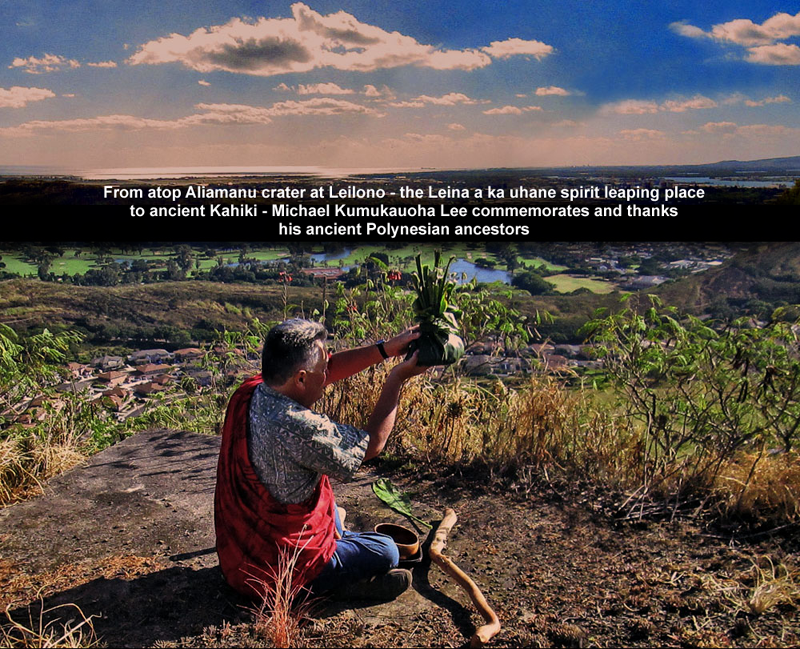
Also of major importance is the identification and location of the Leina a ka Uhane, a sacred spiritual leaping off place for souls returning to the ancient homeland of Tahiti. This is a National Register eligible TCP, yet HART and the SHPD administrator has continuously tried to minimize the importance and geographic area of this TCP as well as apparently intentionally misidentify its location, despite the error being brought to their attention several times since last year.

The previous Rail AIS also failed in many ways to adequately document important Honouliuli-Ewa cultural sites such as the greater Ewa Plantation and railway network that was the largest private railway in Hawaii. The Oahu Railway that served Honouliuli-Ewa plantation railway was chartered under King David Kalakaua.

A Cultural Landscape Report (CLR) is the primary report that documents the history, significance and treatment of a cultural landscape. A CLR evaluates the history and integrity of the landscape including any changes to its geographical context, features, materials,and use.

John Bond
Kanehili Cultural Hui

---------- Forwarded message ----------
From:  <Susan.A.Lebo@hawaii.gov>
Date: Fri, May 31, 2013 at 9:17 AM
Subject: Confirmation of Receipt of Comments on Honolulu Rail AIS

Hello John,

I'm writing to confirm receipt of your public review comments on the
HART AIS via in-person delivery at 3:02pm 5/30/2013.

Thank you in advance for your public comment.

Sincerely,

Susan

Susan A. Lebo, PhD
Oahu Lead Archaeologist
State Historic Preservation Division
Kakuhihewa Building
601 Kamokila Blvd., Suite 555
Kapolei, Hawaii 96707
Susan.A.Lebo@hawaii.gov
(808) 692-8019

###################################################### 

Ewa Plantation Prime Ag Land Still Retains Centuries Old Traditional Agricultural Features

West Oahu Residents Speak Out At Important Ag Lands And Hoopili Station Meetings


FTA and HART Rail Misrepresent The True Ewa Honouliuli Native Hawaiian Spirit Pathway


Honouliuli Ewa TCP's Are Important Wahi Pana (Sacred Places) On Multi-Dimensional Levels


Honouliuli Ewa's Makakilo Kalo'i Gulch - A Rare In Depth Survey Of This Important Cultural Property

Saturday, July 25, 2015

Federal Judge Wallace Tashima Ruled City Rail Must Identify Above-Ground TCPs Within The Rail Corridor

Federal Judge Wallace Tashima Ruled City Rail Must Identify Above-Ground TCPs Within The Rail Corridor

by John Bond   Kanehili Cultural Hui


Federal Judge Tashima, who is overseeing the case after all 7 of Hawaii’s U.S. District judges were recused, agreed the city failed to consider the traditional cultural properties,

Another lawyer who has followed this case closely, said: "Whenever a judge finds that the government acted 'arbitrarily and capriciously' those are code words to lawyers: the government went way 'off the rails,' so to speak. It takes quite a bit of convincing to get a judge to reach that conclusion,  so the arguments the plaintiffs put on must’ve really convinced Judge Tashima."

The Hawaii Supreme Court ruled in a unanimous 82-page opinion in Kaleikini v. Yoshioka, that the City did not comply with the State's historic preservation and burial protection laws when it failed to complete an archeological inventory survey for the 20-mile route before starting construction.

The lawsuit was brought by Paulette Kalekini, a native Hawaiian whose ancestors’ iwi or bones may be displaced by the rail. Her case, which was argued by the Native Hawaiian Legal Corporation on her behalf, brought the rail project to a halt on August 27, 2012. The court maintained "it is undisputed that the rail project has a 'high' likelihood of having a potential effect on archeological resources...."

There is no discussion in the record of the Section 4(f) eligibility of any identified TCPs other than Chinatown, and the FEIS and PA suggest that only “preliminary” efforts have been made to investigate whether meaningful cultural properties are situated within the Project corridor. Because Defendants have presented no reason why it would have been unreasonably difficult to identify such above-ground TCPs prior to issuance of the ROD, this decision to delay full study of above-ground TCPs was arbitrary and capricious.

Before continuing with the Project in any way that may use unidentified TCPs, Defendants must complete their identification of above-ground TCPs within the corridor.

For any TCPs identified, Defendants must conduct a complete Section 4(f) analysis. The ROD must be supplemented to include any newly identified TCPs. The FEIS must also be supplemented to the extent that this process requires changes that “may result in significant environmental impacts
‘in a manner not previously evaluated and considered.’”

Constructive Use Determinations

A Section 4(f) site is “used” when land is permanently incorporated into a transportation facility, when there is a temporary occupancy of land that is adverse in terms of the statute’s preservation purpose, or when there is a constructive use of land. 23 C.F.R. § 774.17; see also Adler, 675 F.2d at 1092 (noting that the term “use” is to be construed broadly to include areas that are significantly, adversely affected by a project but are not physically taken).

The regulations provide: A constructive use occurs when . . . the project’s proximity impacts are so
severe that the protected activities, features, or attributes that qualify the property for protection under Section 4(f) are substantially impaired. Substantial impairment occurs only when the protected activities, features, or attributes of the property are substantially diminished.

3. Analysis of Environmental Consequences
An EIS must contain a “reasonably thorough discussion” of a project’s environmental consequences and mitigation measures. Nat’l Parks & Conservation Ass’n, 606 F.3d at 1072-73; see also 42 U.S.C. § 4332(2)(C). The EIS must discuss the project’s direct effects and reasonably foreseeable indirect and cumulative effects, including growth-inducing effects.

C. NHPA
Plaintiffs argue that Defendants have failed to meet their duty to assess the indirect effects that historic resources other than Chinatown and Merchant Street located near the rail stations will suffer due to the project. The NHPA requires agencies to assess whether historic properties will suffer adverse effects, which occur when an undertaking may alter, directly or indirectly, any of the characteristics that qualify a property for inclusion in the National Register. 36 C.F.R. § 800.5(a)(1). The agency must then consult with relevant parties to develop and evaluate alternatives and modifications to the undertaking that could avoid, minimize, or mitigate those adverse effects. 36 C.F.R. § 800.6(a); Muckleshoot Indian Tribe, 177 F.3d at 805 (observing that § 106 is a “stop, look, and listen” provision requiring agencies to consider the effects of their programs). A PA can serve as evidence of the agency’s compliance with these requirements. 36 C.F.R. §
800.6(c).

III. Conclusion and Remedy
For the reasons set forth above:
A. The Court grants Plaintiffs’ Motion for Summary Judgment (Doc. 109) with respect to: (1) their Section 4(f) claims that Defendants arbitrarily and capriciously failed to complete reasonable efforts to identify above-ground TCPs prior to issuing the ROD;

/s/ A. Wallace Tashima
A. WALLACE TASHIMA
United States Circuit Judge
Sitting by Designation

########################################################### 

Ewa Plantation Prime Ag Land Still Retains Centuries Old Traditional Agricultural Features

West Oahu Residents Speak Out At Important Ag Lands And Hoopili Station Meetings


FTA and HART Rail Misrepresent The True Ewa Honouliuli Native Hawaiian Spirit Pathway


Honouliuli Ewa TCP's Are Important Wahi Pana (Sacred Places) On Multi-Dimensional Levels


Honouliuli Ewa's Makakilo Kalo'i Gulch - A Rare In Depth Survey Of This Important Cultural Property

FTA Funded HART Rail Has Greatly Corrupted Hawaii's Already Corrupt City And State Government

How Much MORE Has FTA Funded HART Rail Corrupted Hawaii's Already Corrupt Government?

Honolulu Ethics Commission Fines Romy Cachola $50K
http://www.civilbeat.com/2014/09/honolulu-ethics-commission-fines-romy-cachola-50k/

State Rep. Romy Cachola has agreed to pay $50,000 to settle an ethics case stemming from his time on the Honolulu City Council.
“This case is a perfect storm of public corruption,” Totto said in the press release.
 People in Kapolei are well aware of how the Kapolei Chamber of Commerce was a primary employer of Nester Garcia who always voted as he was paid to do...

Ribellia is a lobbyist for Hawaii Operating Engineers Industry Stabilization Fund.

She’s also a former staffer for Honolulu City Council Chairman Ernie Martin.

Retiring City Clerk Bernice Mau, however, was troubled by the inclusion of Ribellia in the resolution.

She submitted written testimony questioning why the deputy clerk position was needed, especially since it had been left vacant for nearly three decades.

City Council Rail Pusher Nestor Garcia Resigns 

From KHON2 News

http://www.civilbeat.com/2015/06/nestor-garcia-resigns-from-khon2-news/

Meanwhile, the case has also exposed — and raised concerns —
about another angle of ethics investigations: what happens to the
lobbyists and other special interests who knowingly contribute to
unethical behavior?

The commission won’t reveal the names of the lobbyists or the
companies they represent that are involved in cases, saying to do
so would have a chilling effect in that lobbyists would be reluctant
to provide evidence against elected officials if they were going
to get into trouble, too.


 People in Kapolei are well aware of all the payments made by Kapolei Development
and Dr. Horton to get the City Council votes they wanted

"Cachola outed Mike Kido, David Rae, Steve Kelly and Cameron Nekota..."

HART Rail Auditor Arrested for Money Laundering


A local businessman with University of Hawaii athletics fundraising ties (and who provides auditing services to HART and OHA and has a contract to overhaul the state's accounting system) was arrested for theft and money laundering.

Patrick Oki, age 45, was picked up by authorities just before 11 a.m. Sunday at the Honolulu International Airport. He’s the managing partner of PKF Pacific Hawaii.

It is alleged that during the period from Jan. 27, 2011, through and including Jan. 27, 2014, he perpetrated four separate and distinct fraudulent reimbursement schemes against PKF Pacific Hawaii LLP, which sustained losses of more than $500,000.


#########################################################

FTA and HART Failed To Recognize 

Federal Judge Ruling On Rail Route TCP's

Ewa Plantation Prime Ag Land Still Retains Centuries Old Traditional Agricultural Features

West Oahu Residents Speak Out At Important Ag Lands And Hoopili Station Meetings


FTA and HART Rail Misrepresent The True Ewa Honouliuli Native Hawaiian Spirit Pathway


Honouliuli Ewa TCP's Are Important Wahi Pana (Sacred Places) On Multi-Dimensional Levels


Honouliuli Ewa's Makakilo Kalo'i Gulch - A Rare In Depth Survey Of This Important Cultural Property


Leilono to Kanehili Kaupe’a - Leina a ka uhane – The Spirit Leaping Place

  KANEHILI CULTURAL HUI Leina a ka uhane – The Spirit Leaping Place of Leilono to Kanehili Kaupe’a Archeological sites in Kanehili have clea...