Showing posts with label Federal Judge Wallace Tashima. Show all posts

Sunday, July 26, 2015

May 2013 Kanehili Hui Comments Sent To Hawaii State Preservation Division Regarding Rail Lawsuit

May 2013 Kanehili Hui Comments Sent To Hawaii State Preservation Division Regarding Rail Lawsuit


Extensive Testimony and Comments Delivered To SHPD
SHPD Confirmation of Receipt of Comments on Honolulu Rail AIS May 31, 2013

by John Bond,   Kanehili Cultural Hui

Aloha,

The ruling of Federal Judge Wallace Tashima on the City rail lawsuit made a special point of noting his concern about the identification of TCP's along the HART rail route. It was later made clear in recent HART meetings that TCP's include ALL CULTURES, not just native Hawaiian, as per Federal law that SHPD, HART and FTA must follow. A great deal was left out of the original 2009 AIS (Archaeological Inventory Survey) of Honouliuli-Ewa that these new comments and documents hope to correct.

The Federal FTA HART rail project is required to also adhere to what is known as "Section 4f." Department of Transportation Act of 1966 special provision - Section 4(f) - which stipulated that DOT agencies- including FTA, cannot approve the use of land from wildlife and waterfowl refuges, public or private historical sites unless the following conditions apply:
1. There is no feasible and prudent alternative.
2. The action includes all possible planning to minimize harm to the
property resulting from use.

Mike Lee, along with Hawaii Thousand Friends, submitted approximately 800 pages of detailed comment and testimony on the the HART Rail AIS- the entire 22 mile route. This package included maps, photographs, emails with many agencies (HART, SHPD, DLNR, BLNR, OIBC, HCDA, etc.)
that go back nearly a decade, as well as news articles, historic research and citations, legal documents and filings, native Hawaiian rights, the Clean Water Act, and much more.

A key issue for Mike Lee is the identification of the ancient coral reef limestone along the Oahu shoreline known as Karst, which connects volcanic mountain lava tube water to the shoreline Karst reef water systems. These water springs feed a shoreline ecosystem and was how ancient Hawaiians managed their fish ponds. The Karst was also of very high spiritual importance to ancient Hawaiians and used for sacred burials, such as downtown Honolulu on the grounds of I'olani Palace where there is an ancient Karst burial cave.

"I wanted them to know that I wasn't just making this up ten minutes ago" said Hawaiian cultural practitioner Mike Lee. "I am a Konohikist- I believe in the ecological management and protection of our very important natural island water systems. Protecting our Wahi Kapu sites is also very important to me "

The Mike Lee testimony and comments concern identification and protection of important Hawaiian cultural sites along the rail route, including wahi pana (sacred sites) and wahi kapu (sacred burial areas) and their inclusion into a TCP (Traditional Cultural Properties) that would make sure these special sites, caves, caverns, springs, ponds and water systems are preserved and not contaminated during rail construction.

Also included were photographs of Kawaiaha'o Church which is a graphic example of early Karst limestone block construction. The church and surrounding walls are made of rough ancient reef from the shoreline and ancient sea shells and marine organisms can be clearly seen. The church is also located on the site of an important ancient Karst spring. Nearby I'olani Palace and the royal guard barracks are also constructed from Karst limestone blocks from the shoreline.

In addition, Kanehili Cultural Hui also submitted another approximately 250 pages of detailed comment and testimony on the the HART Rail AIS- primarily concerned with the Honouliuli-Ewa area and the documentation of previously unidentified Traditional Cultural Properties (TCP), Ewa Historic Districts, Ewa Dec 7, 1941 Battlefield Area and an outline for a Honouliuli-Ewa Cultural Landscape Report. Many current or former Ewa Village residents helped by supplying historic documents, maps, photos and oral histories.

The Kanehili Hui name comes from the original Hawaiian name for the Honouliuli-Ewa area and is mentioned by Hawaiian goddess Hi'iaka in her famous and often quoted chants when she traveled through the Ewa Plains area aprroximately 1000 years ago. The Kanehili Cultural Hui 501-c-3 non-profit community organization is concerned with the entire cultural history of the area- from ancient times to modern times.

A key focus of the Kanehili Cultural Hui report and testimony was on the 1825 Malden Trails (ancient Hawaiian Trails- believed to have possibly been originally constructed by very early Tahitian arrivals to Kanehili) which played a major role in the Hawaiian cultural history of the Honouliuli-Ewa area, and which was ENTIRELY LEFT OUT of the HART Rail AIS. The fixed guideway and stations directly overlay the 1825 trails as well as the Kalo'i Karst waterway that flows to the Ewa shoreline.

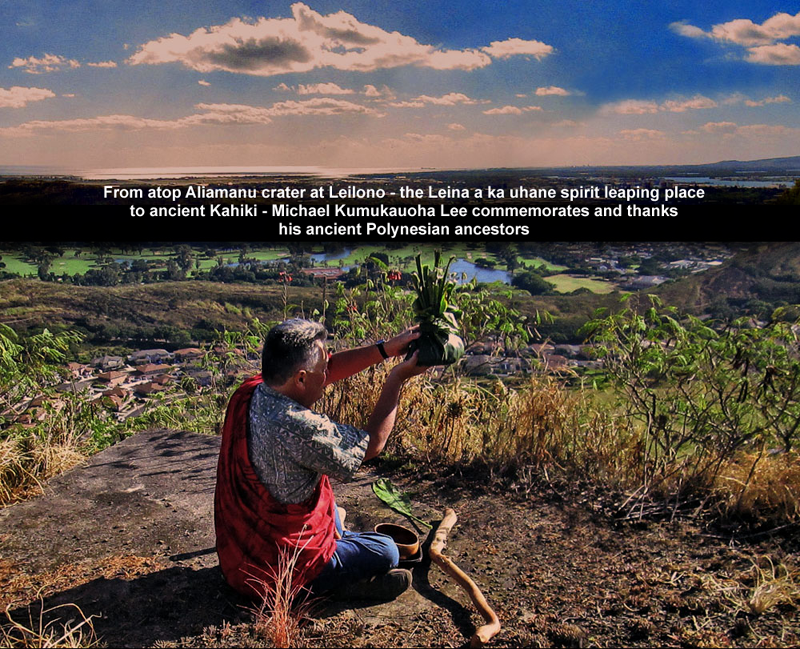
Also of major importance is the identification and location of the Leina a ka Uhane, a sacred spiritual leaping off place for souls returning to the ancient homeland of Tahiti. This is a National Register eligible TCP, yet HART and the SHPD administrator has continuously tried to minimize the importance and geographic area of this TCP as well as apparently intentionally misidentify its location, despite the error being brought to their attention several times since last year.

The previous Rail AIS also failed in many ways to adequately document important Honouliuli-Ewa cultural sites such as the greater Ewa Plantation and railway network that was the largest private railway in Hawaii. The Oahu Railway that served Honouliuli-Ewa plantation railway was chartered under King David Kalakaua.

A Cultural Landscape Report (CLR) is the primary report that documents the history, significance and treatment of a cultural landscape. A CLR evaluates the history and integrity of the landscape including any changes to its geographical context, features, materials,and use.

John Bond
Kanehili Cultural Hui

---------- Forwarded message ----------
From:  <Susan.A.Lebo@hawaii.gov>
Date: Fri, May 31, 2013 at 9:17 AM
Subject: Confirmation of Receipt of Comments on Honolulu Rail AIS

Hello John,

I'm writing to confirm receipt of your public review comments on the
HART AIS via in-person delivery at 3:02pm 5/30/2013.

Thank you in advance for your public comment.

Sincerely,

Susan

Susan A. Lebo, PhD
Oahu Lead Archaeologist
State Historic Preservation Division
Kakuhihewa Building
601 Kamokila Blvd., Suite 555
Kapolei, Hawaii 96707
Susan.A.Lebo@hawaii.gov
(808) 692-8019

###################################################### 

Ewa Plantation Prime Ag Land Still Retains Centuries Old Traditional Agricultural Features

West Oahu Residents Speak Out At Important Ag Lands And Hoopili Station Meetings


FTA and HART Rail Misrepresent The True Ewa Honouliuli Native Hawaiian Spirit Pathway


Honouliuli Ewa TCP's Are Important Wahi Pana (Sacred Places) On Multi-Dimensional Levels


Honouliuli Ewa's Makakilo Kalo'i Gulch - A Rare In Depth Survey Of This Important Cultural Property

Saturday, July 25, 2015

Federal Judge Wallace Tashima Ruled City Rail Must Identify Above-Ground TCPs Within The Rail Corridor

Federal Judge Wallace Tashima Ruled City Rail Must Identify Above-Ground TCPs Within The Rail Corridor

by John Bond   Kanehili Cultural Hui


Federal Judge Tashima, who is overseeing the case after all 7 of Hawaii’s U.S. District judges were recused, agreed the city failed to consider the traditional cultural properties,

Another lawyer who has followed this case closely, said: "Whenever a judge finds that the government acted 'arbitrarily and capriciously' those are code words to lawyers: the government went way 'off the rails,' so to speak. It takes quite a bit of convincing to get a judge to reach that conclusion,  so the arguments the plaintiffs put on must’ve really convinced Judge Tashima."

The Hawaii Supreme Court ruled in a unanimous 82-page opinion in Kaleikini v. Yoshioka, that the City did not comply with the State's historic preservation and burial protection laws when it failed to complete an archeological inventory survey for the 20-mile route before starting construction.

The lawsuit was brought by Paulette Kalekini, a native Hawaiian whose ancestors’ iwi or bones may be displaced by the rail. Her case, which was argued by the Native Hawaiian Legal Corporation on her behalf, brought the rail project to a halt on August 27, 2012. The court maintained "it is undisputed that the rail project has a 'high' likelihood of having a potential effect on archeological resources...."

There is no discussion in the record of the Section 4(f) eligibility of any identified TCPs other than Chinatown, and the FEIS and PA suggest that only “preliminary” efforts have been made to investigate whether meaningful cultural properties are situated within the Project corridor. Because Defendants have presented no reason why it would have been unreasonably difficult to identify such above-ground TCPs prior to issuance of the ROD, this decision to delay full study of above-ground TCPs was arbitrary and capricious.

Before continuing with the Project in any way that may use unidentified TCPs, Defendants must complete their identification of above-ground TCPs within the corridor.

For any TCPs identified, Defendants must conduct a complete Section 4(f) analysis. The ROD must be supplemented to include any newly identified TCPs. The FEIS must also be supplemented to the extent that this process requires changes that “may result in significant environmental impacts
‘in a manner not previously evaluated and considered.’”

Constructive Use Determinations

A Section 4(f) site is “used” when land is permanently incorporated into a transportation facility, when there is a temporary occupancy of land that is adverse in terms of the statute’s preservation purpose, or when there is a constructive use of land. 23 C.F.R. § 774.17; see also Adler, 675 F.2d at 1092 (noting that the term “use” is to be construed broadly to include areas that are significantly, adversely affected by a project but are not physically taken).

The regulations provide: A constructive use occurs when . . . the project’s proximity impacts are so
severe that the protected activities, features, or attributes that qualify the property for protection under Section 4(f) are substantially impaired. Substantial impairment occurs only when the protected activities, features, or attributes of the property are substantially diminished.

3. Analysis of Environmental Consequences
An EIS must contain a “reasonably thorough discussion” of a project’s environmental consequences and mitigation measures. Nat’l Parks & Conservation Ass’n, 606 F.3d at 1072-73; see also 42 U.S.C. § 4332(2)(C). The EIS must discuss the project’s direct effects and reasonably foreseeable indirect and cumulative effects, including growth-inducing effects.

C. NHPA
Plaintiffs argue that Defendants have failed to meet their duty to assess the indirect effects that historic resources other than Chinatown and Merchant Street located near the rail stations will suffer due to the project. The NHPA requires agencies to assess whether historic properties will suffer adverse effects, which occur when an undertaking may alter, directly or indirectly, any of the characteristics that qualify a property for inclusion in the National Register. 36 C.F.R. § 800.5(a)(1). The agency must then consult with relevant parties to develop and evaluate alternatives and modifications to the undertaking that could avoid, minimize, or mitigate those adverse effects. 36 C.F.R. § 800.6(a); Muckleshoot Indian Tribe, 177 F.3d at 805 (observing that § 106 is a “stop, look, and listen” provision requiring agencies to consider the effects of their programs). A PA can serve as evidence of the agency’s compliance with these requirements. 36 C.F.R. §
800.6(c).

III. Conclusion and Remedy
For the reasons set forth above:
A. The Court grants Plaintiffs’ Motion for Summary Judgment (Doc. 109) with respect to: (1) their Section 4(f) claims that Defendants arbitrarily and capriciously failed to complete reasonable efforts to identify above-ground TCPs prior to issuing the ROD;

/s/ A. Wallace Tashima
A. WALLACE TASHIMA
United States Circuit Judge
Sitting by Designation

########################################################### 

Ewa Plantation Prime Ag Land Still Retains Centuries Old Traditional Agricultural Features

West Oahu Residents Speak Out At Important Ag Lands And Hoopili Station Meetings


FTA and HART Rail Misrepresent The True Ewa Honouliuli Native Hawaiian Spirit Pathway


Honouliuli Ewa TCP's Are Important Wahi Pana (Sacred Places) On Multi-Dimensional Levels


Honouliuli Ewa's Makakilo Kalo'i Gulch - A Rare In Depth Survey Of This Important Cultural Property

Leilono to Kanehili Kaupe’a - Leina a ka uhane – The Spirit Leaping Place

  KANEHILI CULTURAL HUI Leina a ka uhane – The Spirit Leaping Place of Leilono to Kanehili Kaupe’a Archeological sites in Kanehili have clea...