Showing posts with label Burial Areas. Show all posts

Monday, December 22, 2014

Ho'opili Project Is Definition Of Insanity - From Transit System To Really Massive Land Development Scheme

Ho'opili Project Is Definition Of Insanity - From Transit System To Really Massive Land Development Scheme

John Bond,  Kanehili Cultural Hui

You have to really wonder why so many experts in soil science, traffic, farming and three former governors OPPOSED the Ho'opili Project. The main PROPONENT for Ho'opili was Ex-Governor Abercrombie and we all know how popular he became after shoving it forward in 2012 with his pro-developer stacked Land Use Commission panel.

H-1 is already a total nightmare and this project will way OVERBUILD West Oahu adding 12,000 more homes on top of many other large home and land development projects. This will literally create a major environmental DISASTER with completely grid locked traffic. Absolutely everything is BAD about this project because it also paves over West Oahu's best farmland and creates massive polluted water runoff that will be directed either into Pearl Harbor or the offshore reef system.

Just for those who don't know, the REAL NAME for this area is not Ho'opili but instead Honouliuli which was a 1000 year old native Hawaiian food bread basket and traditional cultural place (TCP) supporting the largest Hawaiian population on the island of Oahu.

http://www.stophoopili.com/watch-testimony.html

Honouliuli farm lands are the Golden Triangle of deep rich chocolate brown volcanic soil fed by a multitude of natural freshwater springs from the Waianae mountains. It remains an ideal location for high volume fresh farm vegetables and sustainable agriculture today and covering it with concrete and asphalt will literally be a crime against the public.

All open areas of the Ewa Plain are now being filled in with buildings, concrete and asphalt. All this polluted surface water has to run off through gutters into either the ocean or permanent holding ponds.


Nearly all of the once bountiful ocean resources are
being killed off around the Ewa Plain...It's becoming a huge, polluted, traffic 
choked nightmare with continuous building approvals by City and State government officials.


This last open farmland area will soon be filled in with buildings, asphalt and concrete. When this was sugar cane fields the water naturally percolated back into the karst aquifer.

FTA and HART Failed To Recognize 

Federal Judge Ruling On Rail Route TCP's


Honouliuli Ewa's Makakilo Kalo'i Gulch - A Rare In Depth Survey Of This Important Cultural Property


Honouliuli Ewa TCP's Are Important Wahi Pana (Sacred Places) On Multi-Dimensional Levels


FTA and HART Rail Misrepresent The True Ewa Honouliuli Native Hawaiian Spirit Pathway


West Oahu Residents Speak Out At Important Ag Lands And Hoopili Station Meetings


Ewa Plantation Prime Ag Land Still Retains Centuries Old Traditional Agricultural Features


A Tomb Stone To A 1000 Year Old Native Hawaiian Traditional Cultural Place


Sunday, August 11, 2013

Honolulu Votes To Desecrate, Destroy Important Hawaiian Cultural Site

City Council, Mayor of Honolulu Votes To Desecrate And Destroy Important Hawaiian Cultural Site With Bill 65

 By John Bond, Kanehili Cultural Hui

Federal EIS Document Shows Location and Importance Of Major Hawaiian Burial Site
All historic and cultural research shows that this Honouliuli-Ewa area is one of the most very important cultural and historic area's in the State of Hawaii. The identified "Leina a ka Uhane"
is an especially sacred wahi pana of the highest level. A HART EIS TCP (Traditional Cultural Place) report in April 2012 documents this.


One could almost say with certainty that there appears to be a sacred "cosmic alignment" of Hawaiian cultural history and western history in this special TCP area. The major aviation fields, beginning with the 1925 Mooring Mast Field, all have in common with the ancient Hawaiian Leina belief, a "spirit leaping" or "flying away" concept. All pilots know the spiritual aspects of flying a plane.
This ancient area, before it became MCAS Ewa and Barbers Point naval airports, was known as Kanehili, which was very much associated in Hawaiian cultural history with birds-"manu" and for special ceremonial bird feathers. In modern times scientists have found in the many Karst sinkholes and caves of this area the bones of ancient rare birds, including large pre-historic birds too large to fly.
The major 1825 mapped trails show Oahu's largest native population- Honouliuli Ewa- centered around rich, fertile lo'i farmlands, clear fresh streams, Karst springs, and linked to mountain forest resources, abundant and prolific shoreline ponds, fisheries and the best limu in on Oahu. Limu is not only very important as a food and medicine, but also a critically important part of the shoreline ecology that is today being destroyed.
This same area is where the ancient Tahitians arrived and planted the first breadfruit tree. Elaborate trails were built to link the many important Kanehili areas with Honouliuli, and were used for the annual Makahiki ceremonies. Hawaiian goddess Hi'iaka describes a journey through this area nearly one thousand years ago. On certain special nights the legions of ancient Hawaiian warriors, killed in the area's epic land battles, are known to march with torches on these same Honouliuli Ewa spiritual trails.
A large area of the most important, rich and fertile ancient Hawaiian farmland on Oahu, going back 1000 years and supporting Oahu's largest Hawaiian population, where the bones of hundreds of thousands of native Hawaiian farmers and island warriors are buried, will soon be covered over by a Texas corporation forever because of City Bill 65.


FTA and HART Rail Misrepresent The True Ewa Honouliuli Native Hawaiian Spirit Pathway 


Honouliuli Ewa TCP's Are Important Wahi Pana (Sacred Places) On Multi-Dimensional Levels


Honouliuli Ewa's Makakilo Kalo'i Gulch - A Rare In Depth Survey Of This Important Cultural Property


Ewa Plantation Prime Ag Land Still Retains Centuries Old Traditional Agricultural Features

West Oahu Residents Speak Out At Important Ag Lands And Hoopili Station Meetings


Tuesday, April 23, 2013

Honolulu Star-Advertiser: Rare native plant stalls land plans for Kalaeloa

Native Hawaiian Akoko Hinders HCDA Development Plans In Kalaeloa, West Oahu


Apr 21, 2013


An endangered native shrub found naturally on a plot of Navy land at the old Barbers Point Naval Air Station and nowhere else on the planet is at the center of a stalled land swap involving the Navy, state and U.S. Fish and Wildlife Service.

The population of Chamaesyce skottsbergii var. kalaeloana, otherwise known as the Ewa Plains akoko, dwindled from about 5,000 plants in 1979 to just over 630 last year, according to the service.

"If something isn't done to conserve this plant, then it's going to go extinct," said Aaron Nadig, a Fish and Wildlife biologist.
 
What should be done — and by whom — appears to be the million-dollar question in a time of ever-tightening budgets.
 
The Hawaii Community Development Authority, which is responsible for redeveloping the shuttered Navy base, said about 250 acres on three parcels, including the one that's home to the akoko, were offered to it after the Fish and Wildlife Service and state Department of Land and Natural Resources turned the land down.
 
The akoko occupies 150 to 160 acres at what used to be the Navy's northern trap and skeet range.
 
In 2011, the HCDA, a state agency, proposed an ambitious solar energy farm for that parcel, as well as on 80 acres of the adjoining southern trap and skeet range. No akoko has been identified on the southern parcel, officials said.
 
That later became a plan for 5 to 10 megawatts of photovoltaics on the northern site and 5 megawatts on the southern parcel, said Anthony Ching, HCDA's executive director.
 
Ching said prospective solar companies could work around the akoko. But in addition to a Fish and Wildlife Service recommendation that 99 acres of the northern site be set aside for an akoko preserve, the service said HCDA would have to be responsible for the ongoing preservation of the plant, Ching said.
 
Developing a conservation management plan, putting in fencing and a firebreak road, doing clearing work, and hiring people to maintain the site and the akoko could cost hundreds of thousands of dollars in short- and long-term costs, Ching said.
 
"Let's call it a million-dollar commitment," he said.
 
Ching said Fish and Wildlife is "trying to establish an unfunded mandate (for HCDA) for a situation for which they themselves chose not to take responsibility."
 
He noted that an earlier proposal had HCDA setting aside 50 acres for akoko on the northern site. The Fish and Wildlife recommendation now is for 99 acres.
 
Both the northern and southern trap and skeet ranges were designated as "critical habitat" for the akoko, officials said.
 
"It (the akoko preservation) is a worthy effort. It's the law. We should protect our endangered species. I have no problem with that," Ching said. "But it can't be unreasonable. You can't expect to create an unfunded mandate and expect and then ask for the world and then seemingly create challenges for that to happen."
 
A photovoltaic field on the northern site alone could bring in a "couple hundred thousand" dollars in rent annually, but Ching said the costs and responsibility for the akoko make the plan — as well as HCDA taking the three sites from the Navy at all — unattractive.
 
Ching said he wasn't sure that the return on 50 acres for solar production on the northern site would justify a $1 million investment to take on responsibility for the akoko.
 
Given the potential costs, the solar plan on the northern and southern sites "is a decision for (the HCDA board) to consider, but my recommendation would not be likely to support that," Ching said.
 
"It doesn't look good, but I'm still seeking to confirm all the particulars," he said.
 
Ching said HCDA will pursue a 5-megawatt solar farm on a separate land parcel it already received at Kalaeloa.
 
The Fish and Wildlife Service, meanwhile, disputes Ching's contention that it didn't want the three parcels of land, which include the two former skeet ranges and Ordy Pond, a nearby 10,000-year-old water-filled karst sinkhole.
 
"That wasn't the situation," said Nadig, the Fish and Wildlife biologist. "The situation was that the Fish and Wildlife Service did want it, and they've actively pursued trying to include that as part of their conservation lands out there at Barbers Point."
 
But Fish and Wildlife didn't have the ability to take the land because of lead contaminants at the old skeet ranges and military dumping in and around Ordy Pond, Nadig maintained.
 
"Without the Navy maintaining liability for those contaminants, then Fish and Wildlife does not have the ability to acquire those lands," he said.
 
The Navy "essentially refused to maintain that (responsibility) and said, ‘You need to take it as is,'" Nadig said.
 
As for the "unfunded mandate" claim that Ching makes against Fish and Wildlife, Nadig said, "We did not impose anything on HCDA, or we're not telling HCDA they have to do anything."
 
Fish and Wildlife has been in contact from the beginning with HCDA and the solar companies that wanted to operate on the land.
 
"We're at a point where we need to protect a large chunk of this land for the species, because it only exists there," Nadig said. "We were very upfront from the beginning — if they can't do that, then maybe they shouldn't look to doing it, and look elsewhere."
 
A 2011 Navy environmental assessment for the disposal of surplus property at the old Barbers Point said the northern trap and skeet range was in active use in 1950 and abandoned sometime before the early 1960s.
 
A lead and arsenic removal project was conducted in 2003 and 2004, with about 52,000 cubic yards of material "stabilized" using "triple super phosphate" and 42,000 cubic yards processed through mechanical screens.
 
The assessment said soil with akoko clusters was manually excavated to preserve the plants.
 
The Navy said the actions cleaned the site to U.S. Environmental Protection Agency "unrestricted use" levels.
 
Nadig said there is still the potential of finding contaminants.
 
"You can still find lead out there," he said.
 
Bill Doughty, a spokesman for Navy Region Hawaii, said a "finding of no significant impact" for the reuse of Barbers Point land requires that the Navy have an akoko conservation and management plan in place before it transfers the land.
 
A nearly $1 million Navy cleanup of Ordy Pond was mounted earlier this year.
 
The endangered native plant that's creating all of the fuss is an unassuming shrub that grows 2 to 4 feet tall with roundish leaves that are shed in the summer. It has very small flowers and fruit, and milky sap.
 
A plant relative that grows on Molokai is genetically different, officials said.
 
Ewa Plains akoko thrived on the coral shelf substrate that underlies the area and which is full of karst sinkholes and underground water ways as a result of erosion.


Tuesday, March 5, 2013

Welcome To Kanehili News - Sacred caves destroyed by Navy Contractors

Welcome To Kanehili News

ancient sacred Hawaiian cultural areas

Sacred caves in Hawaii may soon be destroyed by Navy Contractors

By John Bond | Mar 06, 2013   Kanehili Cultural Hui
 
HAWAII - Incredible Kanehili Ewa Karst Caves may be destroyed by Navy Contractors drilling and burying ancient sacred Hawaiian cultural areas without benefit of an Archaeological Inventory Survey. A Federal consultant said that this area likely contains hundreds if not THOUSANDS of Hawaiian burials as an area of the Leina a ka Uhane- spirit leaping place within Kanehili.

Most images are from a video camera placed down into cave entrances as we lacked cave exploration equipment to venture into them. The Kanehili Cultural Hui (KCH) is working to bring National Geographic and other investigative news organizations on the mainland to send out reporters to do a story about this major injustice.

The Navy has refused a request for consultation with KCH about archaeological discoveries and supplied documentation about major Karst Caves which are below their HECO (Hawaiian Electric Company) Power Line and PV Farm construction project. Prior military history notes Karst caves as large as railway cars and storage of WW-II bombs in such caves next to the airfield that was attacked on December 7, 1941.

The Navy's own test surveys also indicate caves but they have refused to share this data, which they had promised to do earlier. In addition they are not allowing cultural monitoring, which they had also promised to do earlier. In addition, the Section 106 for the project was completely rigged and not signed off on by any of the local Ewa Community because of the Navy arrogance to fix the outcome the way they wanted it.

Many of the Incredible Kanehili Karst Caves areas are surrounded by walls. Numerous important sinkholes and cave entrances have been found just this past weekend and shot on high-definition video. It is an established fact that these caves are hydrologically connected and water flows through them to the ocean. Further this area was designated by a Federal HART TCP survey as a major "Leina a ka Uhane" sacred place and recommended for the National Historic register as a Traditional Cultural Property.

Sacred caves in Hawaii may soon be destroyed by Navy

The Navy has refused Archaeological Inventory Survey despite all of the documented evidence that goes back to 1925 when the Ewa Mooring Mast was first constructed in this area. 1925 photos show the extensive coral limestone sinkholes and caves of the area and 1941 Ewa airfield construction further documents them.

These cave discoveries are makai (ocean side) of the Ewa Field area where Hunt Corp is currently putting in their solar farm and HECO is drilling down 9 feet below the surface to install a major 46 kV power line. An ancient Hawaiian implement which may possible be a kukui nut oil lamp was previously found, possibly used for going down into and exploring such caves by ancient Hawaiians.

The Navy refuses to do an Archaeological Inventory Survey despite all the evidence that they will be busting into ancient Hawaiian caves just below ground using boring and drilling equipment. This entire area was a major ancient Hawaiian cultural site with rich cultural significance and mentioned in the 1000 year old chants of Hi'iaka.


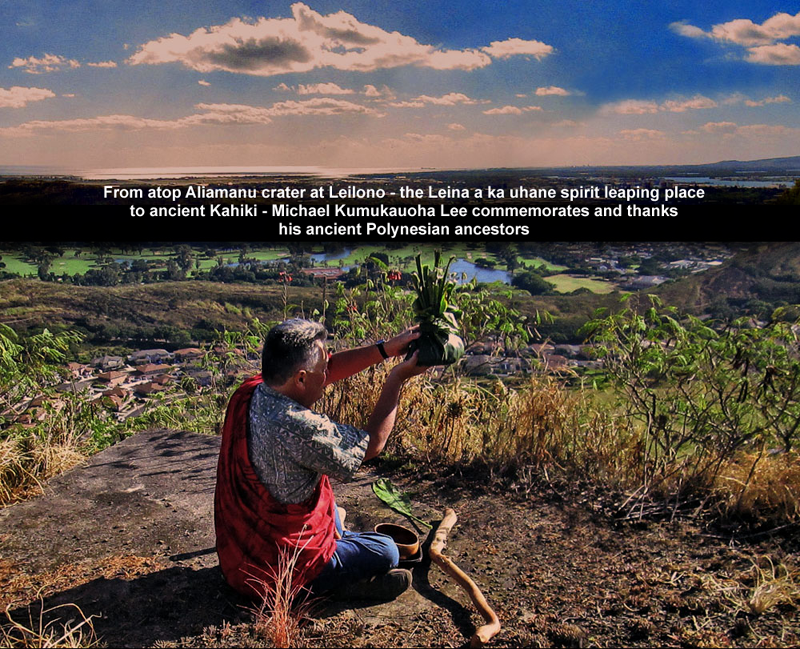
Leilono to Kanehili Kaupe’a - Leina a ka uhane – The Spirit Leaping Place

  KANEHILI CULTURAL HUI Leina a ka uhane – The Spirit Leaping Place of Leilono to Kanehili Kaupe’a Archeological sites in Kanehili have clea...